Get Your Quote in 30 Seconds
You’re one step away from stress-free accounting. Click below, share a few details, and we’ll send you a no-obligation quote today.


Affordable Accounting, Bookkeeping & Making Tax Digital Services in the UK
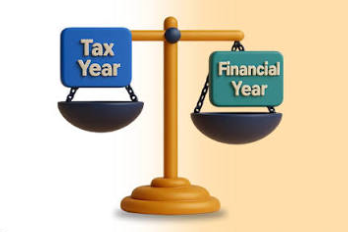
The tax year is fixed for everyone: it runs from 6 April to 5 April and drives your personal tax. A financial year belongs to your company: it is the 12 months your accounts cover, it is set when the company is formed, and you can change it. The current tax year, 2026/27, runs from 6 April 2026 to 5 April 2027, but a limited company’s financial year can end on any date in the calendar.
Most of the confusion around financial year vs tax year comes from the fact that a company director lives with both at once, plus a third calendar: the government’s own financial year, which runs from 1 April and sets Corporation Tax rates. This guide explains what each year is, which deadlines follow which clock, and when it is worth lining them up.
Source: Income Tax rates and Personal Allowances (GOV.UK)
The tax year, sometimes called the fiscal year, runs from 6 April in one year to 5 April in the next. It applies to everyone and cannot be changed. Income Tax, National Insurance, dividend tax and Capital Gains Tax are all worked out over this period, and allowances such as the £12,570 Personal Allowance reset with it.
The deadlines that follow the tax year are the personal ones. Self Assessment registration, the 31 January online filing and payment deadline, and payroll reporting for employers all key off 5 April. If you are a sole trader, a landlord or a company director taking salary and dividends, this is the year that decides your personal tax bill.
Source: Income Tax rates and Personal Allowances (GOV.UK)
A limited company’s financial year is the period its annual accounts cover. It is anchored to the company’s accounting reference date, which Companies House sets automatically when the company is formed: the last day of the month in which the company was incorporated, one year on.
So a company incorporated on 11 May has an accounting reference date of 31 May the following year, and its first accounts cover roughly 12 months and 3 weeks, from the day of incorporation to that date. After that, each financial year is normally the 12 months to the same date. Because a Company Tax Return cannot cover more than 12 months, a first set of accounts that runs longer can mean filing two tax returns for that first stretch.
Source: Your limited company’s first accounts and Company Tax Return (GOV.UK)
The practical difference is that the two years run different deadline clocks. Personal deadlines are fixed dates in the calendar, the same for everyone. Company deadlines roll forward from your own year end, so every company’s calendar is different.
The company clock works like this:
A company with a 30 September 2026 year end therefore files accounts by 30 June 2027 and pays Corporation Tax by 1 July 2027, while its director still faces the same 31 January Self Assessment deadline as everyone else. Two calendars, both live at once.
Source: Accounts and tax returns for private limited companies (GOV.UK)
The government sets Corporation Tax rates by its own financial year, which runs from 1 April to 31 March. This is the year the Treasury uses when it announces rates, which is why announcements talk about changes ‘from 1 April’.
For the financial year that began on 1 April 2026, the rates are: a small profits rate of 19% on profits up to £50,000, the main rate of 25% on profits over £250,000, and marginal relief in between, which gradually raises the effective rate as profits grow. Two details catch companies out. The £50,000 and £250,000 thresholds are reduced proportionately if your accounting period is shorter than 12 months, and they are also divided by the number of associated companies you have.
Your company does not need to use these dates itself. Its accounting period simply determines which financial year’s rates apply to its profits.
Source: Corporation Tax rates and reliefs (GOV.UK)
Not in any way that matters for tax any more. Since 6 April 2023, HMRC taxes sole traders and partners on the profits arising in the tax year itself, whatever period their accounts are drawn up to. The 2023/24 year was the transition, and from 2024/25 the tax year basis applies in full.
There is one helpful simplification. If your accounting year ends on any date from 31 March to 4 April, you can treat it as ending on 5 April, so no apportionment is needed for the few days in between. In practice this is why most sole traders now keep books to 31 March or 5 April: any other date means splitting two sets of accounts across each tax year.
Source: Changes to reporting income from self employment and partnerships (GOV.UK)
Yes. You can shorten your financial year as many times as you like, by as little as one day. Lengthening is more restricted: normally once every 5 years, up to a maximum of 18 months, with exceptions if the company is in administration, you are aligning dates with a subsidiary or parent company, or Companies House gives special permission. You cannot change your year end at all while your accounts are overdue.
Be aware that changing the date also changes your filing deadline, except when you lengthen your first financial year. Many owner-managed companies choose to move their year end to 31 March. It lines the company up with the Corporation Tax financial year and sits within a few days of the personal tax year, which makes planning salary, dividends and pension timing noticeably simpler.
The trade-off is workload timing: a 31 March year end puts your accounts preparation in the same season as everyone else’s. There is no single right answer, which is why the choice is worth making deliberately rather than by default.
Source: Change your company’s year end (GOV.UK)
Take an illustrative example. Sana incorporated her marketing company in Dudley on 11 September 2025, so Companies House set her accounting reference date at 30 September. Her first accounts run from 11 September 2025 to 30 September 2026 and are due 21 months after registration, by 11 June 2027. Because a tax return cannot cover more than 12 months, that first period needs two Company Tax Returns.
Her company’s profits are taxed at the rates set for the government’s financial years its accounting period falls into, at 19% if profits stay at £50,000 or below. Meanwhile the salary and dividends she pays herself are taxed by the personal tax year, so her 2026/27 Self Assessment return is due by 31 January 2028 regardless of her company’s dates. This example is for illustration only.
The 2026/27 tax year runs from 6 April 2026 to 5 April 2027. The next one starts on 6 April 2027. These dates are fixed and apply to everyone in the UK.
Almost. Your accounting period for Corporation Tax is normally the same 12 months as the financial year your annual accounts cover. They can differ, most commonly in a company’s first year, because an accounting period cannot be longer than 12 months.
It is popular for a reason: it matches the Corporation Tax financial year and sits close to the personal tax year, which simplifies planning. But it is not automatic. Seasonal cash flow, group structures and how a change moves your filing deadlines all matter, so take advice before filing the change.
Yes, in two situations. They are reduced proportionately if your accounting period is shorter than 12 months, and they are divided across associated companies. Two associated companies effectively share the thresholds, so each hits the main rate sooner.
No. Any year end from 31 March to 4 April can be treated as 5 April, so 31 March works fine. A very different date, such as 30 June, is still allowed but means apportioning profits across tax years, which adds work every single year.
Once the three calendars are mapped for your business, the deadlines stop being a source of surprises. WV4 Accountants can help you:
If the financial year vs tax year distinction is blurring your deadlines or your planning, contact WV4 Accountants and we will put the right dates, and the right structure, around your business.
Important note: This article provides general information. Tax treatment depends on individual circumstances. Current HMRC guidance should be checked before action is taken.
You’re one step away from stress-free accounting. Click below, share a few details, and we’ll send you a no-obligation quote today.